
The Economic Warfare Programme
Private Brief 01 Threshold

Private programme · For families, principals and heirs · 51°45′N 1°15′W

Economic Warfare Fortune favours the prepared.

They tell you to worry about the markets, but never to worry about people. Wealth is always exposed to people.

Capital is rarely destroyed in one dramatic moment. It is lost through a sequence of decisions nobody challenged:

  • An heir given responsibility before readiness.
  • A trusted friend whose confidence replaces diligence.
  • A private investment approved without independent scrutiny.
  • A family dispute left unresolved.
  • A marriage without financial clarity.
  • Addiction, ego or impulse given access to capital.

These patterns are recognisable. Many are preventable.

We do not manage assets, sell financial products or recommend investments. We teach families responsible for eight-figure wealth how fortunes are lost — and how discipline, governance and independent challenge can protect them across generations.

A private, referral-led programme · Two to three days · No sponsors · No pitches · No public attendee list

Explore the doctrine

Folio I The anatomy of loss

Fortunes are rarely breached at the walls.

They fail first within the structure.

SEC. AA EAVE II PIANO NOBILE GROUND FOUNDATIONS
Plate I — Section AA. Exterior as found. Failures marked as they arise.
01Family
Inheritance without preparation. Unresolved expectations. Succession without authority or alignment.
02Influence
Friends, partners and advisers whose access exceeds their accountability.
03Private deals
Conviction replacing diligence. Concentrated bets, informal loans and investments driven by loyalty.
04Governance
No independent investment committee. No dissenting voice. No formal approval process. Nobody empowered to say no.
05Behaviour
Impulse, ego, urgency, lifestyle escalation and addiction gaining access to capital.
06Marriage and separation
Unclear ownership, competing loyalties and arrangements made only after conflict begins.
07Deception
Fraud, manipulation, conflicted advice and trust deliberately exploited.

The threat is rarely invisible. It is simply recognised too late.

Folio II Doctrine

Wealth is freedom of action.

Not merely the value of what a family holds, but the ability to move, decide and act when conditions turn. Most wealth education begins with acquisition. This programme begins with survival — because the first cannot outlast the loss of the second.

The doctrine · in four paragraphs

Conventional wealth management is optimised for normal conditions. Diversification across asset classes, a trusted bank, a well-drafted trust and a good adviser are sufficient for a world in which markets clear, transfers settle and the law changes slowly. That world is not the only one a family will live in.

Economic warfare is what happens when the rules change faster than the structures built under them. Purchasing power is quietly taken by debasement. Capital is frozen by controls that were unthinkable the year before. A custodian fails, a jurisdiction turns hostile, a signature is compromised, a founder dies without a decision matrix. None of these are exotic. All of them have happened to families who considered themselves diversified.

The programme's method is borrowed from institutions that survive adversity as a matter of routine: intelligence before instruments. Map the exposures, fortify the structure, rehearse the crisis, and maintain the advantage through disciplined, quarterly attention. Preparedness is not a mood. It is an asset.

Everything the programme does is lawful and intended to remain so. This is resilience, diversification, governance and preparation — never concealment, evasion or the frustration of legitimate authority. A family that must hide is not free. A family that is prepared is.

Intelligence before instruments. — The Council, MMXXVI
The six doctrines

I

Trust, then verify

Respect the relationship. Independently verify the claim, the incentives, the authority, the custody and the downside.

II

Slow is smooth under pressure

Urgency is a risk signal, not a reason. Material decisions require a pause, a second signature and an explicit exception.

III

No single point of failure

No individual, account, adviser, device, institution or jurisdiction should be able to compromise the family alone.

IV

Separate person from proposition

A beloved friend can introduce a bad investment. A difficult expert can deliver a correct warning. Judge the claim on its own.

V

Document the dissent

A credible committee records its assumptions, conflicts, contrary evidence and kill criteria — and who is allowed to stop the process.

VI

Rehearse before the crisis

Roles, channels, escalation thresholds and professional contacts are designed while nobody needs them. That is the only time they can be.

Folio III History

Four centuries of losses. One pattern.

Bubbles and frauds are taught as separate subjects. They are not. Both depend on capable people accepting a story in place of evidence. The cases below are chosen because the victims were not fools: they were bankers, auditors, scientists and the most sophisticated investors of their day.

Ledger A · Spectacular bubbles1636 – 2008

  1. 1636–37

    Tulip Mania

    Contracts for rare bulbs reached thousands of guilders. Then the buyers simply disappeared, and prices collapsed within weeks.

    Amsterdam

  2. 1720

    Mississippi Bubble

    France combined a central bank, a money printer, the national debt and a colonial company in one structure. Shares rose twentyfold, then lost roughly 95%.

    Paris

  3. 1720

    South Sea Bubble

    A company promising riches from largely imaginary trade rose from about £100 to £1,000, then returned to roughly £100. Isaac Newton lost heavily.

    London

  4. 1840s

    Railway Mania

    Parliament approved 263 railway schemes in a single year; about a third were never built. Investment equalled around 7% of Britain’s national income.

    Britain

  5. 1980s

    Japanese asset bubble

    On paper, the grounds of the Imperial Palace were worth more than all the real estate in California. The Nikkei took thirty-four years to recover its peak.

    Tokyo

  6. 1995–2000

    Dot-com bubble

    Companies with no profits — sometimes barely a product — raised fortunes for having “.com” in the name. The Nasdaq then fell 77%.

    Nasdaq

  7. 2000–08

    U.S. housing bubble

    Mortgages borrowers could barely afford were repackaged as supposedly safe securities. House prices fell more than 20% and nearly took global finance with them.

    United States

Ledger B · Investor frauds1980s – 2022

  1. 1980s

    ZZZZ Best

    A teenager took his carpet-cleaning company public on fabricated restoration contracts, and staged fake work sites for the auditors.

    Public stock

  2. 1997

    Bre-X

    The “world’s largest gold discovery” was made by adding gold dust to rock samples. C$6 billion vanished; the geologist fell from a helicopter.

    Public stock

  3. 2001

    Enron

    Executives hid debt and booked years of hypothetical profit at once. The stock went from $90 to pennies — and destroyed its auditor too.

    Public stock

  4. 2002

    WorldCom

    Management created more than $9 billion of false entries, turning ordinary expenses into imaginary assets and profit.

    Public stock

  5. 2003

    Parmalat

    A forged bank letter claimed almost €4 billion sat in one account. The eventual hole was around €14 billion.

    Public stock

  6. 2009

    Satyam

    More than 6,000 fake invoices and bogus bank statements created over $1 billion of non-existent cash — half the company’s assets.

    Public stock

  7. 2008

    Bernard Madoff

    Almost nothing was invested. Withdrawals were paid from new deposits while fabricated statements showed impossibly steady returns.

    Investment scam

  8. 2018

    Theranos

    More than $700 million raised for blood-testing technology that could not do what was claimed. Demonstrations and financials misled sophisticated investors.

    Venture

  9. 2020

    Wirecard

    A DAX fintech claimed €1.9 billion in bank cash that apparently never existed. It collapsed; its chief operating officer disappeared.

    Public stock

  10. 2020

    Luckin Coffee

    Employees fabricated more than $300 million of coffee sales, then built fake databases, expenses and bank records to support them.

    Public stock

  11. 2020

    Nikola

    The founder promoted a truck as operational when it was not. The famous demonstration video showed it rolling downhill.

    SPAC

  12. 2021

    HeadSpin

    Fake revenue and customer figures produced a $1.1 billion valuation. After investigation it was cut to $300 million.

    Venture

  13. 2014–19

    OneCoin

    Over $4 billion put into a “cryptocurrency” that was essentially worthless. Its founder vanished and remains a wanted fugitive.

    Investment scam

  14. 2022

    FTX

    One of the most respected names in crypto secretly diverted customer money to its trading arm. More than $8 billion was taken.

    Venture & customers

What bubbles teach us

  1. I

    A real trend becomes an unlimited story

    Railways, the internet, housing and global trade were genuine opportunities. The mistake was believing that a valuable development justified any price.

  2. II

    Rising prices become the evidence

    As prices increase, success appears to confirm the original thesis. Valuation is replaced by momentum, and popularity is mistaken for truth.

  3. III

    Social proof silences independent judgment

    When governments, institutions and sophisticated investors participate, caution begins to feel irrational. Fear of missing out becomes stronger than fear of loss.

  4. IV

    Liquidity conceals fragility

    Bubbles survive while new buyers and easy financing remain available. When confidence weakens, liquidity disappears — and the market discovers that price was never the same as value.

The lesson

The most dangerous bubbles are built around something real. A sound idea can still become an absurd investment at the wrong price.

Ask yourself:

  • Does the product add true value?
  • Before you invest, do you have a trusted independent committee to advise you?

What corporate frauds teach us

  1. I

    Control becomes concentrated

    Fraud flourishes when a small group controls operations, financial reporting, information and access to the underlying assets.

  2. II

    Reported success replaces verifiable cash

    Revenue, customers, technology and bank balances appear impressive on paper but cannot be independently confirmed. The organisation controls the evidence used to validate its own claims.

  3. III

    Reputation replaces due diligence

    Prestigious investors, auditors, banks and directors create borrowed credibility. Each participant assumes someone else has performed the necessary verification. Always make sure the founders have the experience to be qualified builders.

  4. IV

    Questions become unwelcome

    Warning signs intensify when management responds to scrutiny with secrecy, complexity, delay or aggression. A culture that punishes dissent eventually protects deception.

The lesson

Corporate fraud rarely succeeds through one convincing liar alone. It succeeds because governance fails, gatekeepers stop questioning and respected outsiders make the lie appear safe.

The essential distinction

A bubble persuades the market to abandon valuation.

A fraud persuades it to abandon verification.

The sequence of a loss · reconstructed backwards from the outcome

Attractive narrative→Trusted introduction→Compressed diligence→Exception to process→Concentration→Concealment→Delayed escalation

Figures from public court records, regulator releases and contemporaneous reporting (SEC, DOJ, FBI, Federal Reserve, Reuters). Losses are stated in the money of the day.

Folio IV The anatomy of human exposure

Every hero was invulnerable — until someone learned where they were not.

Strength does not eliminate vulnerability. It makes knowledge of that vulnerability more valuable.

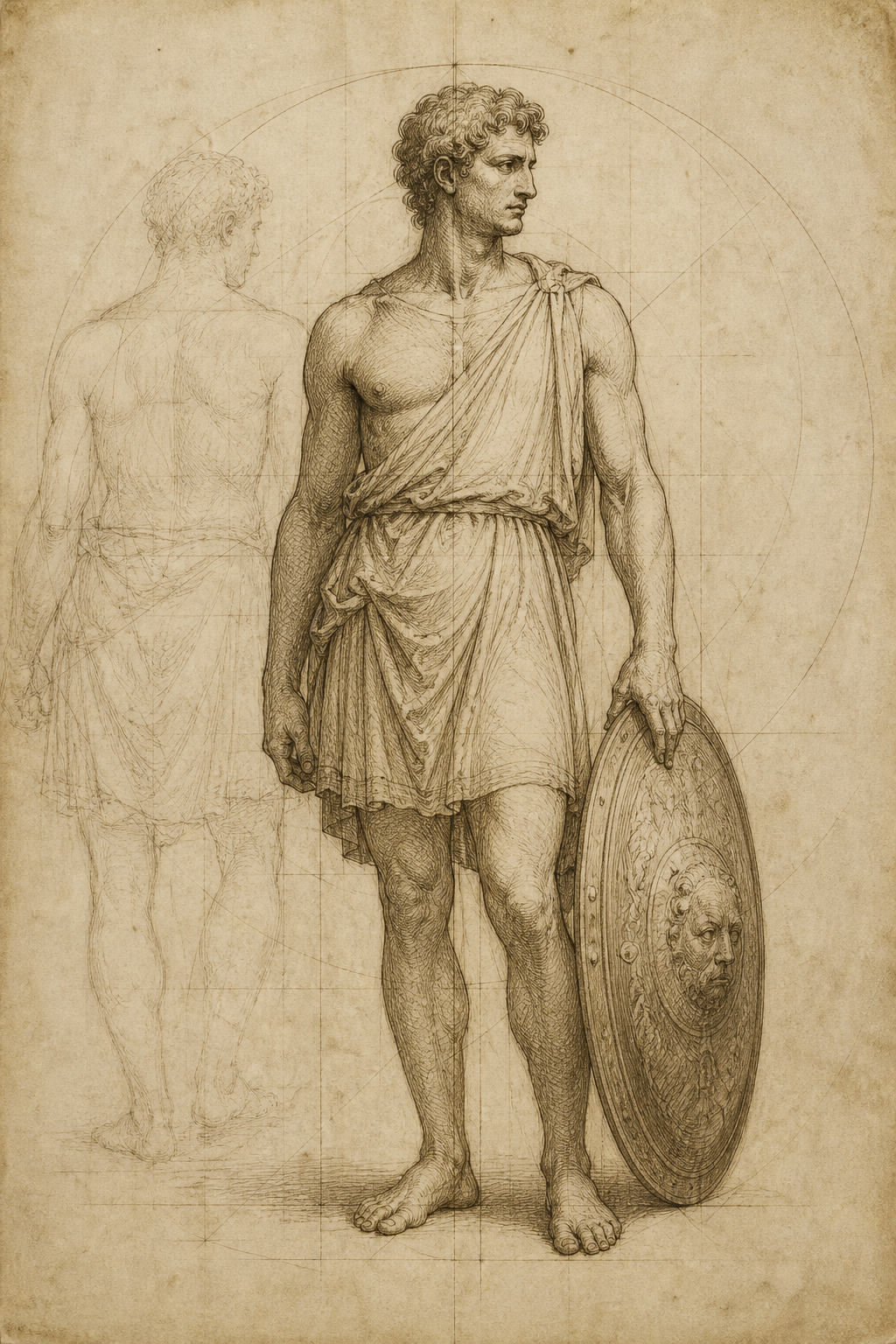
Across mythology, history and saga, the most powerful figures rarely fell because they lacked strength. They fell because they trusted the wrong person, disclosed the wrong secret, ignored the right warning, or believed one weakness did not matter. The figure is not Achilles, Siegfried or Samson. He is the principal: trained, protected, still human.

The anatomy of human exposure · Plate IV

Anatomical study of a defender: frontal figure with shield, faint dorsal study behind.
Fig. IV — Eight marks on a defender. The myths are not decoration. Each is a lesson in how protection is penetrated when judgment fails. Hover or tap a mark.
  1. Mark 01

    Achilles’ heel

    Protected everywhere except one small point. Near-total protection produced confidence; the remaining exception decided the outcome.

    What single weakness could bypass every other defence you have built?

  2. Mark 02

    Siegfried’s linden leaf

    Kriemhild revealed the one place the armour never covered, believing the knowledge would protect him. It was used to kill him.

    Who knows precisely where your protection ends?

  3. Mark 03

    Samson’s lock

    Extraordinary strength. Persistent pressure inside an intimate relationship extracted the secret by which he could be defeated.

    What have you disclosed because intimacy felt like proof of loyalty?

  4. Mark 04

    Lear’s crown

    He transferred power according to declarations of love. Those who flattered him received authority; the daughter who spoke honestly was rejected.

    Who gains influence by telling you exactly what you want to hear?

  5. Mark 05

    Cassandra’s warning

    Troy did not lack intelligence. It lacked the ability to hear, and act upon, unwelcome intelligence.

    Who is permitted to contradict you before a decision becomes irreversible?

  6. Mark 06

    Ariadne’s broken thread

    She gave Theseus the intelligence that let him survive the labyrinth. After receiving what he needed, he left her behind.

    Where have you provided capital, access or knowledge without securing alignment?

  7. Mark 07

    Roland’s horn

    Betrayed into an ambush, then compounded by pride: he refused to call for assistance until rescue had become impossible.

    Where might asking for help feel more threatening than the crisis itself?

  8. Mark 08

    The Trojan horse

    The walls were not forced. The danger was welcomed inside as a gift. The gates were opened from within.

    What have you allowed inside your perimeter because it arrived as a gift, introduction or privilege?

  1. Baldr’s mistletoe

    The dismissed exception

    Which risk have you dismissed because it appears harmless?

  2. Leonidas’ hidden pass

    The insider route

    Who knows the route around your formal controls?

  3. Osiris’ fitted chest

    The bespoke trap

    Which opportunity appears almost too perfectly tailored to your ambitions?

  4. Caesar’s inner circle

    The trusted hand

    Who inside your circle benefits if your judgment fails?

What failure looks like

Divorce. Family fragmentation. Fraud. Predatory investments. Business capture. Litigation. Reputational damage. Cyber and identity compromise.

A fortune may survive volatility. It rarely survives repeated decisions made without scrutiny.

The defence doctrine

The programme teaches participants to:

  1. assess character, incentives and leverage before granting access
  2. separate personal trust from financial authority
  3. verify introductions, claims and conflicts independently
  4. establish an investment committee with genuine challenge power
  5. define approval thresholds, documentation and escalation rules
  6. prepare for divorce, dispute, incapacity, fraud and succession
  7. recognise manipulation before it becomes measurable loss

External pressure

Beyond the human perimeter, the programme examines the external conditions that magnify loss: legal conflict, jurisdictional change, liquidity shocks, capital restrictions, cyber intrusion, reputational attacks and political interference. These threats matter. But they are usually most destructive when poor judgment or weak governance has already created the opening.

We do not teach you how to make money. We teach you how not to lose it.

Not wealth management. Not investment advice. Defensive education for the preservation of judgment, control and capital.

Folio V The outer perimeter

These risks remain yours — even when their management is delegated.

The Economic Warfare Programme concentrates on human threats, compromised judgment and governance failure. It does not manage portfolios, custody assets, structure taxes or provide legal advice. Yet these external exposures can still destroy substantial wealth and must have clearly assigned institutional owners.

A capable family office should coordinate them. An independent investment committee should challenge them. Private banks, custodians, lawyers and tax advisers should execute within defined mandates. Delegated does not mean covered. If nobody can identify the owner, limits, evidence and contingency plan, the risk is unmanaged.

Beyond the human perimeterFig. V · Outer chart

  1. External threat 01

    Monetary and currency erosion

    Inflation and currency depreciation can silently destroy purchasing power while balances and nominal returns continue to rise.

    • Income and reserves concentrated in one currency
    • Nominal performance mistaken for real returns
    • Cash treated as permanently risk-free

    Expected coverage Family office, investment committee and private bank.

  2. External threat 02

    Jurisdictional concentration

    Residency, entities, assets and advisers concentrated in one legal or political system leave a family vulnerable to sudden regulatory, tax or political change.

    • Exit options exist on paper but have never been tested
    • Assets and structures depend on one jurisdiction
    • All advisers operate within the same system

    Expected coverage Family office, independent legal and tax counsel, with investment-committee oversight.

  3. External threat 03

    Seizure and interference

    Asset freezes, sanctions spillover, litigation, regulatory enforcement and political interference can affect families that were never the intended target.

    • Counterparties connected to exposed or designated persons
    • Beneficial ownership records that can be misunderstood
    • No pre-agreed legal, banking or communications response

    Expected coverage Family office, independent legal counsel and relevant banking or compliance specialists.

  4. External threat 04

    Custody and counterparty failure

    An asset may be legally owned yet inaccessible when a bank, custodian, broker or other counterparty fails.

    • Excessive reliance on one institution
    • Unclear ownership, segregation or creditor protection
    • No secondary banking or custody relationship
    • Counterparty strength assumed rather than monitored

    Expected coverage Family office, private banks, custodians and investment committee.

  5. External threat 05

    Liquidity and capital controls

    Net worth is not liquidity. A family can remain wealthy on paper while losing the ability to move or access its capital during a crisis.

    • Illiquid exposure beyond crisis tolerance
    • No liquidity ladder or emergency reserves
    • Credit facilities dependent on the same concentrated assets
    • Transfer restrictions and backup access never tested

    Expected coverage Family office, investment committee and private bank.

  6. External threat 06

    Concentration, leverage and market shock

    Fortunes are often destroyed not by one incorrect forecast, but by one exposure being allowed to become existential.

    • One company, asset, sector or geography dominates
    • Leverage magnifies losses or creates forced selling
    • Maturity and currency mismatches remain hidden
    • No position limits, stress tests or exit rules

    Expected coverage Investment committee and family office, supported by private banks and specialist advisers.

The coverage protocol

For every external threat, the principal should be able to ask:

  1. Who is accountable for monitoring it?
  2. What limits have been established?
  3. What evidence is reviewed, and how often?
  4. Who independently challenges the responsible institution?
  5. What happens if the bank, adviser or assumption fails?
  6. What is the pre-agreed contingency plan?

The Economic Warfare Programme does not manage these exposures. It teaches you how to determine who should, how to demand evidence, and how to recognise when delegated risk is, in reality, unmanaged.

You cannot delegate ownership of the threat. Only its management.

Folio VI Field test

Capital Resilience Index

One useful instrument. Four concentrations, one directional reading. It reveals structural fragility; it does not pretend to be advice and it asks for nothing before it answers.

Instrument 01 · Capital Resilience Index Directional · not financial advice
45%

Political and legal concentration

40%

Ability to act under time pressure

55%

Monetary and transfer risk

50%

Operational counterparty risk

Resilience reading

—/ 100

Move a dial to begin.

The reading is structural. It says nothing about returns and everything about how much of the family's freedom of action rests on one point.

    Directional diagnostic only. Not financial, legal or tax advice. The full threat map is built from a forensic inventory, not four sliders.

    Folio VII Programme

    Three days to examine the decisions your family cannot afford to get wrong.

    The flagship is an intensive residential programme for twelve to eighteen households. Founders who built companies worth more than US$200 million, investors, forensic specialists, family-governance practitioners and vetted former intelligence and crisis professionals teach from the decisions they made, the signals they missed and the systems they changed afterward. No theory from a stage.

    Length
    Three days, with a private arrival dinner the evening before. A two-day format exists only for closed institutional cohorts.
    Cohort
    Twelve to eighteen households or principals. Never more than twenty-four people in the room.
    Setting
    A discreet five-star or private estate venue with controlled access and secure breakout rooms.
    Method
    Cold cases, red team against blue team, pre-mortems, decision journals and a tabletop crisis. Every session ends in a decision, a tool or a rehearsal.
    Devices
    Phone-free teaching rooms with secure storage.
    Record
    None. No filming, no recordings, no attendee list, no social posting, no external guests, no pitches.
    1. I

      Judgment

      Distinguish conviction from persuasion, evidence from status, and urgency from necessity.

      Modules I · III

    2. II

      Capital

      Build a repeatable diligence and investment-committee system before money moves.

      Modules IV · V

    3. III

      Trust

      Protect relationships without confusing affection, familiarity or prestige with verification.

      Modules II · IX

    4. IV

      Continuity

      Prepare the family for succession, cyber compromise, coercion, reputational shock and personal crisis.

      Modules VI · VII · VIII · X

    Ten modules · one lifecycle of preventable loss

    1. I
      The Anatomy of LossHow do capable people lose fortunes?
    2. II
      The Trusted CircleWho can hurt you precisely because you trust them?
    3. III
      Influence & DeceptionHow are rational people moved away from evidence?
    4. IV
      Investment DisciplineWhat must be true before capital moves?
    5. V
      The Investment CommitteeWho challenges the decision — and can they stop it?
    6. VI
      Family GovernanceHow does wealth survive relationships and generations?
    7. VII
      Digital & Information DefenceWhat can be stolen without entering the home?
    8. VIII
      Personal & Family CrisisWhat happens if a family member is threatened, missing or abducted?
    9. IX
      Reputation, Law & CoercionHow do legal, reputational and regulatory pressures create bad decisions?
    10. X
      The Continuity SystemWhat changes on Monday morning?

    Module depth, cases and faculty are disclosed to admitted participants only. Cohort dates follow eligibility, not the other way round.

    What the family takes home

    An operating system, not a souvenir.

    Practical tools owned by the family and retained by nobody else. The programme improves the quality of judgment; it never guarantees the preservation of wealth.

    • Influence and fraud red-flag card
    • Investment decision memo and diligence checklist
    • Investment-committee charter and decision-rights matrix
    • Family continuity map
    • Private crisis contact tree
    • Confidential Human Exposure Session
    • Personal and family exposure mapPrivate outcome of the session. Not collected. Not shared. Not retained.

    The Private Human Exposure Session

    The programme’s most personal exercise is completed privately.

    Each participant answers a structured series of questions about themselves, their relationships and their family system. Responses are neither collected nor shared. Each person decides what, if anything, they wish to discuss.

    The objective is not to identify enemies or judge whether someone is “good” or “bad.” It is to reveal where trust, access, pressure, dependency or unclear authority could produce human error.

    Not every threat comes from a malicious person. Good people under desperation, fear, grief, dependency, addiction or financial pressure can also make deeply destructive decisions.

    Questions explored privately

    1. Who currently has access to my capital, information, reputation and decisions?
    2. Where has someone’s access increased faster than their accountability?
    3. Where am I relying on affection, loyalty, status or reputation instead of verification?
    4. Which relationships make it difficult for me to establish or enforce boundaries?
    5. Who could commit the family financially without independent challenge?
    6. Where could dependency gradually become entitlement?
    7. Which family members may be particularly vulnerable to pressure, influence or manipulation?
    8. Which uncomfortable conversation am I postponing?
    9. If someone I trust became desperate, what could they access?
    10. If my judgment became compromised, who would be capable of challenging me?

    The result is not a list of people to fear. It is a private map showing where trust may be carrying too much weight, where boundaries require reinforcement and where governance is missing.

    Discernment, not paranoia

    We sharpen judgment with the precision of a Japanese blade — not so that participants become suspicious of everyone, but so they can distinguish:

    • loyaltyfromdependency
    • confidencefromcompetence
    • affectionfrominfluence
    • opportunityfrompressure
    • trustfromunchecked authority

    Fear closes doors. Blind trust leaves them unguarded.

    Doubt may kill more dreams than failure ever will. But the wrong dream, protected from scrutiny, can become a nightmare.

    Folio VIII Council

    Exclusivity without credibility is theatre.

    The Council is the programme's faculty and standing body of practitioners. Disciplines, not personalities. Every person at the front of the room has a verified reason to be there and a defined boundary around what they may claim. Names are shared with admitted families, and only where a name increases trust.

    Founders & operators

    Built or led companies valued above US$200 million. Concentration, governance, betrayal, liquidity, and the mistakes that actually mattered.

    Unicorn founders

    Verified roles in billion-dollar companies. Scale, scrutiny, boards, and what visibility does to a family.

    Former intelligence & military

    Formally former, appropriately vetted. Decision-making under uncertainty, protective planning, information discipline.

    Forensic finance & fraud

    Fraud patterns, beneficial ownership, payment controls, evidence handling and the moment to escalate.

    Investment professionals

    Institutional diligence, committee design, conflict transparency and the evaluation of managers and founders.

    Family governance

    Authority, succession, incapacity, next-generation preparation and the conduct of dissent across generations.

    Crisis professionals

    Prevention, family roles, escalation and aftercare. Licensed, insured and coordinated with the relevant authorities.

    Data scientists

    Anomaly detection, reconciliation, scenario analysis and the neutral review of evidence when opinions collide.

    The faculty code

    No products. No commissions. No classified material.

    Independence
    Faculty are paid a fixed fee, unrelated to any transaction. Nobody at the front of the room sells, solicits or takes a referral fee — and neither does the programme.
    Boundaries
    No classified or unlawfully obtained information, ever. No implied endorsement by any government, service, bank or former employer. Former means former.
    Disclosure
    Conflicts and commercial relationships are disclosed in writing before the session. Cases are anonymised or consented. No participant's story becomes marketing.
    Format
    Twenty-five minutes of case, twenty of moderated interrogation, twenty-five of application. No keynotes. No panel of six people saying nothing.

    Folio IX Continuity

    The work begins when the room closes.

    Attendance is the start of a longer discipline. Three services continue it: closed education, neutral analysis and scoped implementation. Never a deal room. Never a sales channel.

    I

    The Continuity Network

    Alumni only. Quarterly closed briefings, an annual tabletop exercise and a confidential memorandum. No promotion, no fundraising, no introductions for sale. Membership is revoked for solicitation.

    II

    The Second Look

    A neutral, evidence-based review of a proposed investment, adviser, custodian or family decision. The programme owns no product and receives nothing from any outcome, so it can say what a salesman cannot.

    III

    The Continuity Office

    Scoped implementation with the family's own advisers: map the exposures, fortify the structure, rehearse the crisis, maintain the advantage. Governance, custody, identity and crisis readiness — coordinated, not replaced.

    From the Network's case library · an excerpt

    Case File 01 · The Trusted Introduction Failure of process Ref. EWP/CF/01 · pp. 2–3 of 11

    § 2 — The sequence

    The introduction came from a friend of years standing, whose own commitment was described as “already in”. The materials were a deck, a two-page summary and a reference call with another investor the same friend had introduced. The family office learned of the investment after the wire, not before. Commitment: share of liquid net worth in a single vehicle, with a term lock.

    No independent diligence was commissioned. No written downside case existed. The family's own charter required a second signature above threshold; the transfer was split into two tranches, each beneath it. The cooling-off period the family had agreed in principle had never been written down, and so did not apply.

    § 3 — Where the loss began

    The vehicle failed months later, for reasons that were knowable at the time of the introduction and were in fact known to two of the other investors. The failure of the investment is the least instructive part of the file. The loss began at four earlier points: when a friend's confidence was accepted as diligence; when the threshold was engineered around; when the office was informed rather than consulted; and when nobody in the room had the authority to say not yet.

    Kill criteria K-02 (introduction by a party with an economic interest) and K-05 (no written downside case) have since been added to the family's charter. Either would have stopped the transfer.

    Excerpt ends. Sections 4–7 withheld. Composite case; identifying details altered. Request the full case file

    Folio X Admission

    The threshold is financial. Admission is personal.

    We do not market, and we do not sell access to a network. Most candidates hear of the programme from a founder, a family, a private bank, a family office or a fund. Net worth opens the file. Character, purpose and the safety of the room decide admission.

    Minimum criteria

    • Threshold. At least eight figures in U.S.-dollar net worth. A minimum, not a promise of admission.
    • Referral. A named referral from an approved partner, alumnus, founder, family or trusted professional. Exceptional direct applicants may be reviewed.
    • Legitimacy. Identity, sanctions and adverse-media screening, source-of-wealth plausibility and references. Proportionate, lawful and discreet.
    • Intent. A genuine educational, governance or protection objective. Not prospecting, fundraising, selling, or access to other attendees.
    • Conduct. Confidentiality, no solicitation, no recording, disclosure of conflicts. Membership of the room is a privilege that can be withdrawn.

    Process

    1. 01
      Referral. A partner or alumni code, or a named source. A name and a way to reach you is enough to begin.
    2. 02
      Application. Identity, motivation, family context and conflicts. The fee is US$400.99 — deliberately precise, deliberately symbolic. It creates a serious threshold and pays for part of the verification. It buys no admission, no priority and no access, and is non-refundable once screening begins.
    3. 03
      Verification. KYC and AML, sanctions and adverse-media screening, source-of-wealth plausibility, references.
    4. 04
      Interview. Thirty confidential minutes. One question decides it: will you improve the room, or endanger it?
    5. 05
      Committee. At least two reviewers; conflicts and rationale documented. Accept, waitlist or decline.
    6. 06
      Contracting. Participant agreement, confidentiality, no-solicitation and recording ban. Tuition is disclosed only now. The seat is confirmed.

    Tuition never published · dates follow eligibility · no manufactured scarcity

    The programme is

    • Education, judgment and decision systems
    • Prevention, governance and continuity
    • Vetted practitioners with lived experience
    • Confidential by contract, not by promise

    The programme is not

    • Investment advice or a place where deals are done
    • A networking club, a masterclass or a retreat with a brand
    • A security service, a law firm or a private intelligence agency
    • A promise of returns, or a guarantee of anything

    For institutions & investors

    Your clients do not need another product. They need a stronger decision system.

    Private banks, family offices, private-equity and venture firms may refer clients, or commission a closed two-day cohort for their own principals. A partner is a referral and delivery channel — never a sponsor. No logos in the room. No influence over admissions, curriculum or findings. No attendee data beyond a partner's own nominees. Attendance is never a condition of banking or fund access.

    The programme is being built as a small, defensible institution: a fixed cohort model, a referral-led pipeline, and three recurring services after the room closes. A limited number of conversations with prospective institutional partners and investors are held each quarter, in person.

    Partner standards and terms shared under confidentiality

    You cannot buy your way into the room.

    You can ask to be considered. Preparedness is an asset — and the only one that cannot be bought after the fact.